Everyone has seen the demand numbers by now. The IEA projects global data center electricity consumption will roughly double to around 945 terawatt hours by 2030. Goldman Sachs estimates $720 billion in grid upgrades will be needed through the same period. Rack power density has gone from 10 kilowatts to over 100 kilowatts in a handful of years. The power required to train and run a single AI cluster can now exceed 100 megawatts.
These numbers are real, and they matter. But ask a data center developer where their project is actually stalled, and the answer is rarely generation capacity. It is the interconnection queue, the line to get a wire in the ground and approved by a utility that is already overwhelmed with requests.
In Virginia, which handles roughly a quarter of all US data center power consumption, grid connection timelines have stretched to seven years in some cases. It takes 12 to 24 months to physically build a data center. Securing a grid connection can take three times as long. That mismatch is what is actually stalling the AI buildout, and no amount of investment in new generation capacity changes it immediately.
The root cause is layered. The grid itself is aging. Over half of US distribution transformers are more than 35 years old, and transformer lead times have gone from weeks to as long as 24 months since 2020. The interconnection queue processes were built for a grid where large loads come along rarely and follow predictable patterns. An AI training cluster that swings from near-zero to 100 megawatts in seconds based on workload is something those processes were never designed to accommodate. And grid operators, rightfully, are nervous about large loads that may cause instability if they disconnect suddenly during a fault.
The result is a kind of paralysis. Developers have power commitments on paper and GPU racks waiting in warehouses, and the thing blocking deployment is getting a wire in the ground and signed off by a utility that is already overwhelmed with requests.
So what actually moves the needle?
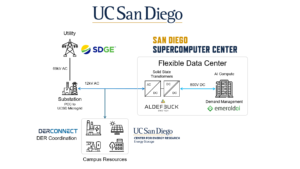
The companies making progress fastest are the ones rethinking the integration architecture itself. Behind-the-meter battery storage is becoming standard practice not because it is cheap, but because it changes the interconnection conversation entirely. A data center that can demonstrate it will absorb grid disturbances locally, smooth its own load profile, and avoid contributing to instability has a fundamentally different relationship with its utility than one that treats the grid as a passive input. BESS co-located with solid-state power conversion allows exactly that. It shifts the facility from being a difficult load to being a cooperative grid participant.
At Alderbuck, this is the problem our Nexus Power Unit and PowerVectorAI™ platform are designed to address at the integration layer. The bottleneck is rarely the total amount of power available. It is the complexity of connecting a data center’s DC architecture to a grid that speaks AC, managing the transition between grid power and backup sources without interruption, coordinating BESS charging and discharging with real-time grid conditions, and doing all of that without a different bespoke stack of equipment at every site.
There is a useful way to think about what has happened over the past few years. The GPU shortage that defined 2023 was a hardware manufacturing problem that got solved through scale. The power problem defining 2025 and 2026 is one of connection and integration architecture. The grid capacity is closer than the interconnection queue makes it appear. The tools to unlock it are the ones that make the integration point smarter, faster, and more capable of adapting to what both the data center and the grid need in real time.
That is the problem worth solving.