The data center industry just took a significant step toward agreeing on what the power infrastructure of next-generation AI facilities should look like.
At the end of Q1 2026, the Open Compute Project Foundation published version 1.0 of its Data Center Facilities Power Distribution whitepaper, a foundational document that charts the industry’s path from today’s legacy AC distribution architecture toward low-voltage direct current systems, with 800VDC as the target architecture for high-density AI infrastructure. More than 190 companies contributed through the CurrentOS and ODCA partnership, making it one of the broadest collaborative efforts the OCP community has ever undertaken. Alderbuck Energy’s Kim McGrath, VP Strategy and Keith Klarer, Chief Software Architect were among the contributors; .
Why does this matter, and why did we want to be part of it
The shift to 800VDC inside data centers represents a fundamental rethinking of how power moves from the grid to the chip, one that the OCP community has now formalized into a shared roadmap. Today’s data centers rely on multiple AC-to-DC conversion stages, each one introducing efficiency losses that compound as power demand scales. The OCP whitepaper frames the problem directly: eliminating those repeated conversion steps could recover 15 to 30 percent of efficiency that the current architecture simply throws away. At the megawatt-scale power densities that AI clusters now require, that number is consequential.
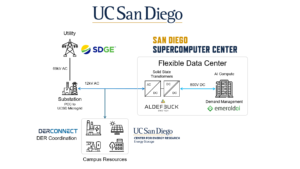
The 800VDC architecture NVIDIA has been driving, and which Google, Meta, and Microsoft have co-developed specifications around, pushes high-voltage direct current distribution from the medium-voltage grid connection all the way to the rack. That path from medium-voltage AC input to 800VDC rack-level output is precisely where solid-state transformer technology fits. An SST handles the conversion natively, without the transformer-inverter-rectifier chain that conventional architecture requires. It also provides the galvanic isolation, bidirectional control, and software-managed energy routing that a DC-native data center needs to operate efficiently and safely at scale.
This is why the whitepaper identifies SST as a core technology in the 800VDC roadmap rather than a peripheral option. The architecture it describes is one that SST-based platforms like the Nexus Power Unit are designed for. Contributing to the document was an opportunity to help shape the technical requirements and integration standards while the specification is still in its early form, rather than adapting to them after they are set.
Version 1.0 is a directional document. It establishes the architecture narrative, outlines the considerations around available voltage options, and sets high-level requirements for system components. The working group has already signaled that future versions will go deeper into specific technical requirements. We will continue to engage as that work develops.
If you are a data center developer, a hyperscaler infrastructure team, or a facility designer starting to plan for 800VDC deployments, the whitepaper is worth reading. You can find it at the OCP Power Distribution project page. And if you want to understand how solid-state transformer technology fits into this architecture from the grid connection inward, our recent posts on what SSTs are and why the AI data center power bottleneck is an integration problem are good places to start.